Oxidative stress is an internal biological imbalance that occurs when your body produces more unstable molecules—called free radicals—than its natural antioxidant defenses can handle. Free radicals are normal byproducts of cell energy production, but factors like pollution, poor diet, and stress can cause them to multiply. When these unneutralized free radicals bounce around inside cells, they act like tiny bits of rust, gradually damaging healthy cell structures, DNA, and proteins over time.
Free Radicals
- Research indicates that electromagnetic fields (EMFs) can lead to increased free radical production in living cells, though not in the same way high-energy radiation does.
- Free radicals are unstable atoms or molecules with an unpaired electron.
- Unlike ionizing radiation (like X-rays or gamma rays), which has enough energy to directly strip electrons from atoms to instantly form free radicals, low-frequency and radiofrequency EMFs (from power lines, phones, or Wi-Fi) do not carry enough energy to break molecular bonds directly.
- Instead, non-ionizing EMFs influence free radical levels through INDIRECT biological mechanisms.
- Numerous in vitro (cell culture) and animal studies show that exposure to both extremely low-frequency (ELF) and radiofrequency (RF) fields can cause a measurable rise in free radicals and oxidative stress markers.
How Excess Free Radicals Damage Cells
- Radical Pair Mechanism: Certain biochemical reactions in the body naturally produce short-lived pairs of free radicals. Magnetic fields can alter the quantum spin state of these radical pairs, slowing down their recombination and allowing more free radicals to escape into the cell.
- Disruption of Calcium Channels: EMFs can affect voltage-gated calcium channels (VGCCs) in cell membranes, causing an influx of calcium ions into cells. Excess intracellular calcium stimulates enzymes like NADPH oxidase, triggering the production of Reactive Oxygen Species (ROS).
- Fenton Reaction Promotion: Some studies suggest EMF exposure can promote the Fenton reaction—a reaction involving iron inside cells that converts hydrogen peroxide into highly reactive hydroxyl radicals.
Oxidative Stress
- An overload of free radicals sets off something called oxidative stress.
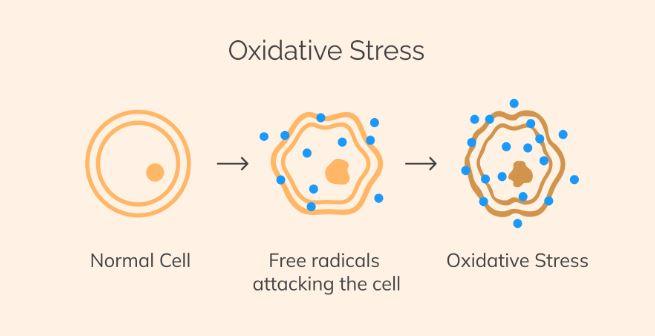
Oxidative Stress
Role Of Antioxidants
- Antioxidants are molecules that help neutralize free radicals.
- They do this by safely donating an electron, stabilizing the free radical without becoming unstable themselves.
- Our bodies naturally produce some of these antioxidants to fight off free radicals. These antioxidants include melatonin and glutathione.
- Under normal conditions there are plenty of antioxidants to fight off the free radicals. However, when the number of free radicals grows exponentially there are not enough antioxidants to repair them.
- Compare a summer camp where there are 100 kids and 100 counselors vs a camp where there are 100 kids and 1 counselor.
- Increased free radicals in the body leads to oxidative stress which can account for many of the biological responses and adverse health effects, including cancer.
DNA Methylation
- DNA methylation is one of the cellular systems affected by radiation. It regulates gene expression by recruiting proteins involved in gene repression or by inhibiting the binding of transcription factor(s) to DNA.
- Consistent DNA hypomethylation have been observed at enhancers regulated by the disease-defining EWS-FLI1 fusion protein, thus establishing epigenomic enhancer reprogramming as a ubiquitous and characteristic feature of Ewing sarcoma.
- Elevated ROS (free radicals) levels can disrupt DNA methyltransferase binding and modify chromatin structure, leading to hypermethylation or hypomethylation of specific genomic regions.
- The cell is equipped with chromosomal repair mechanisms but these are not 100% effective.
- DNA repairing enzymes are more effective in single-strand breaks than in double-strand breaks. If both strands of DNA are mutually damaged, they cannot repair the problem, and the damage results in cell death.
Sample Tumor Profile
- My son Matthew had a tumor profile conducted in August 2025.
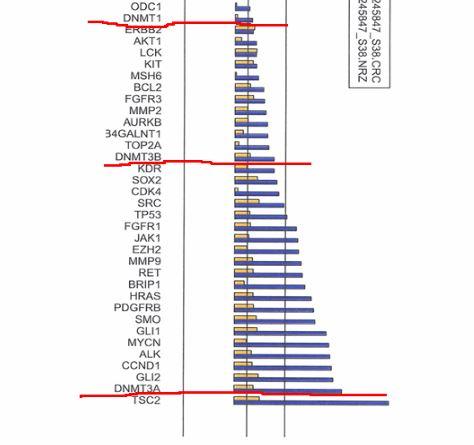
- Sample of tumor profile is detailed in below figure. Bar charts to the right of the center line are significantly overexpressed genes. Bar charts to the right of the rightmost line are highly significant overexpressed.
- 2 of these overexpressed genes (DNMT1 and DNMT3B) are DNA methylation overexpressed genes and are significant over-expressions.
- 1 of these overexpressed genes (DNMT3A) is also a DNA methylation over-expression and is a highly significant over-expression. It is the second highest overexpressed tumor in the entire list.